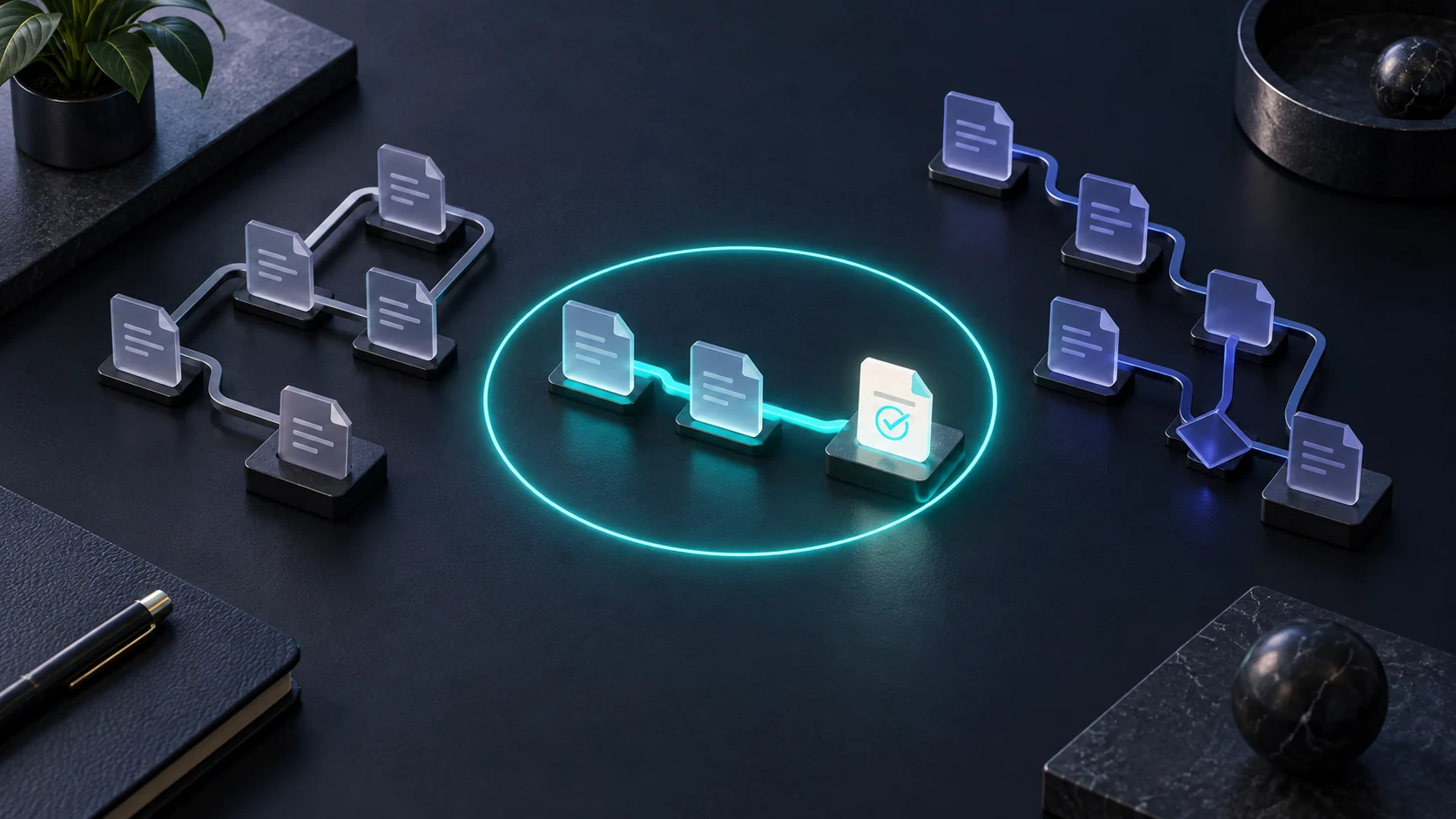
The best first AI automation project is a repeated workflow with a clear owner, accessible inputs, a checkable result, and a safe way to handle mistakes. Choose a bounded pilot that reduces a real operational burden. Measure the whole process, including human review and exception handling, before expanding it.
Start with a week of actual work
A useful starting point is the work your team repeats, not a list of AI features. Ask the people handling intake, documents, scheduling, and reporting to record recurring tasks for a week. Capture what starts the task, where the information comes from, what someone does with it, and how they know it is finished.
Look for copying between systems, reading similar documents, chasing missing information, and assembling the same report. Record exceptions too. A task that looks consistent from a manager's desk may involve several different decisions when someone performs it.
For each candidate, collect:
- The person responsible for the final result.
- Typical volume and time spent per completed item.
- The systems and accounts involved.
- Common missing, contradictory, or duplicate inputs.
- The consequences of a wrong or delayed result.
- The evidence you could use to check whether the automation helped.
These observations become a small discovery brief. They also prevent an estimate from depending on an idealized process that nobody actually follows.
Separate rules from interpretation
If an invoice number already exists in a database, checking for a duplicate is usually a rule. If a request contains a known service selection, routing it to the corresponding team may need a standard integration. Those steps do not become better just because a language model participates.
AI becomes more relevant when information arrives in varied language or inconsistent documents. It can propose categories, extract candidate fields, or draft a summary. The surrounding application still needs to validate values, enforce permissions, and decide what happens when the proposal is uncertain.
A sensible pilot can combine both approaches: a model interprets an attachment, ordinary code checks required fields, and a person approves the proposed record. The choice is made step by step, rather than labeling the entire operation an AI project.
Apply three readiness gates
Before comparing potential benefits, check whether the workflow is ready to be automated.
- Ownership: Someone can explain the process, review outputs, and decide when the pilot is acceptable.
- Access: The relevant records and integrations can be used with approved permissions. A shared login or an export somebody might find later is not a confirmed dependency.
- Recovery: The team can stop the automation, identify affected records, and return to a manual process.
If one of these is missing, preparation is the first project. NIST's AI Risk Management Framework organizes risk work across governance, mapping, measurement, and management; it provides a useful reference for treating deployment as an ongoing responsibility. Read the NIST framework.
Compare the candidates using the same questions
For workflows that pass the gates, compare frequency, handling effort, input consistency, integration complexity, and the cost of an error. A frequent task with a small number of systems and an obvious acceptance check is often a more useful first pilot than a complex process touching every department.
Avoid collapsing serious risks into a single numerical score. A high-volume workflow should not win merely because its potential time savings outweigh a low score for permission or recoverability. Treat those as requirements, then use business value to prioritize the remaining options.
Consider an illustrative nonprofit intake process. Staff read a form and attachment, type selected details into a tracking system, and email a colleague. A bounded pilot could prepare the proposed record and place it in a review queue. Automatically deciding eligibility, making payments, and sending final decisions would be a different scope with different consequences. This example describes a possible design, not a reported client result.
Define success before the build
Choose a baseline period and a representative sample of work. Track completion time, staff handling time, corrections, duplicate records, and exceptions that remain unresolved. After introducing the pilot, use comparable work and include the time spent reviewing its output.
Document what counts as an error and who records it. A dashboard that shows successful API requests cannot tell you whether the correct information reached the right record. Inspect outcomes in the destination system and keep a small audit sample.
The next step is a one-page pilot brief: workflow, owner, inputs, permissions, proposed action, human checkpoint, success measures, and fallback. Kre8ivTech's AI automation service begins with that practical scope. You can also request a project with examples of the repeated work your team wants to improve.